How Can a Vacuum Sizing & Cooling Tank Improve Pipe Production Quality?
In plastic pipe manufacturing, consistent dimensions, a smooth surface finish, and reliable product quality are essential to meeting customer specifications. A vacuum sizing and cooling tank plays a crucial role in the plastic pipe extrusion process by helping manufacturers control pipe dimensions, stabilise shape, and cool the extruded material efficiently.
Whether manufacturing PVC, HDPE, or other thermoplastic pipes, the right vacuum sizing and cooling equipment can improve dimensional consistency, reduce production defects, and support stable manufacturing operations. By combining vacuum calibration with controlled water cooling, this equipment helps pipes achieve their required outside diameter, roundness, and shape stability during production.
Jimkhaas Extrusions provides a relevant point of contact for businesses exploring plastic pipe extrusion equipment. In this guide, we explain how a vacuum sizing and cooling tank works, its key benefits, industrial applications, and the factors to consider when selecting equipment for a pipe extrusion line.
What Is a Vacuum Sizing & Cooling Tank?
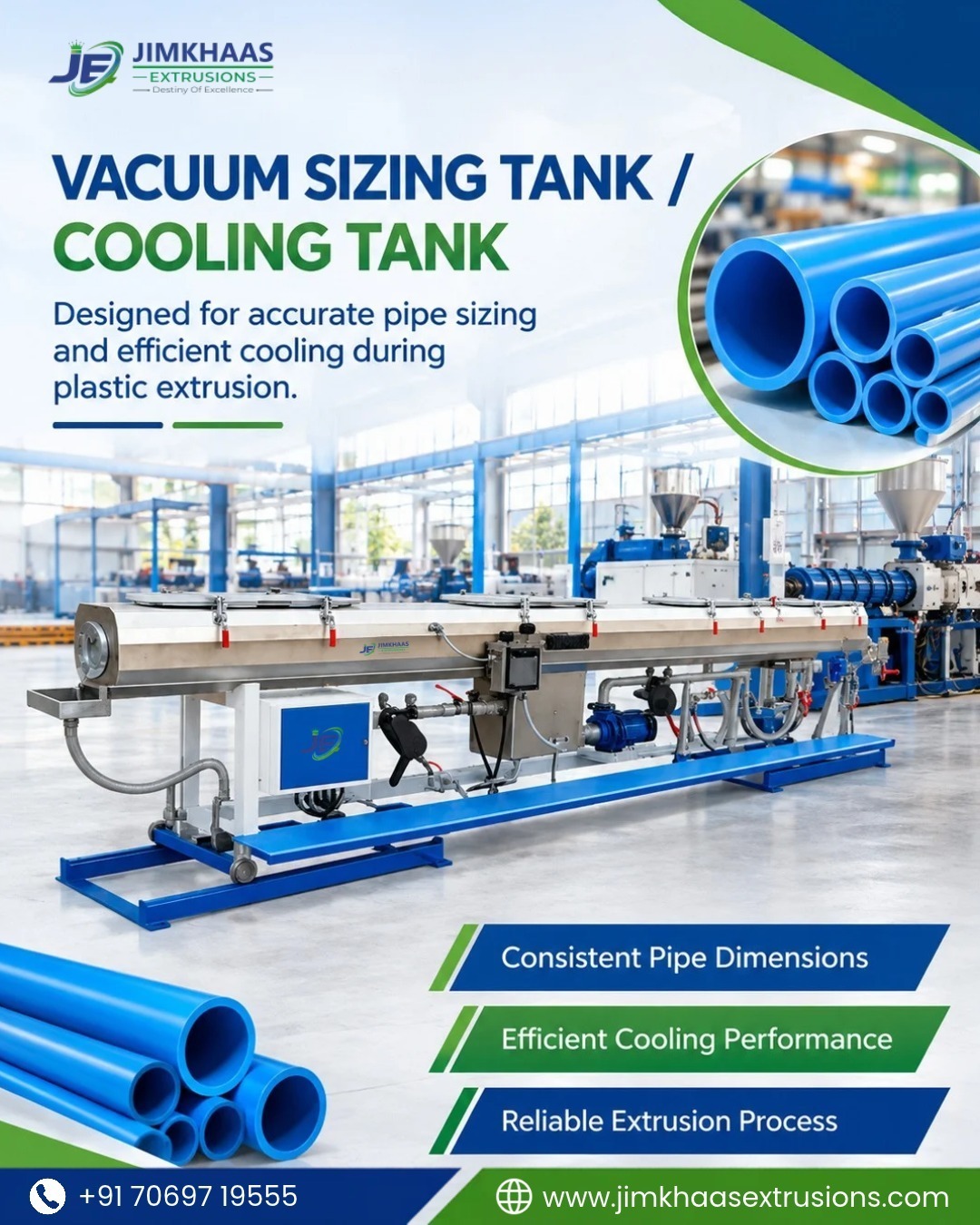
A Vacuum Sizing & Cooling Tank is an important component of a plastic pipe extrusion line. Installed downstream of the extrusion die, it calibrates and cools the pipe as it moves through the manufacturing process.
The vacuum sizing system uses controlled negative pressure to draw the hot extruded pipe against a sizing sleeve or calibration device. This establishes the required outside diameter while the cooling system removes heat from the pipe.
Combining vacuum calibration with water cooling lets the pipe gradually stabilise before moving to downstream haul-off and cutting equipment.
A typical vacuum sizing and cooling tank may include:
* Vacuum system: Creates controlled negative pressure to calibrate the pipe.
* Sizing sleeve or calibration unit: Helps maintain the required pipe diameter.
* Water cooling system: Removes heat from the extruded pipe.
* Spray nozzles or water distribution system: Directs cooling water around the pipe.
* Tank body and sealing arrangements: Support calibration and cooling.
* Control system: Helps operators monitor and adjust operating parameters.
Equipment configuration varies by pipe material, diameter range, wall thickness, production speed, and extrusion line requirements.
1. How Does a Vacuum Sizing & Cooling Tank Improve Dimensional Accuracy?
Dimensional accuracy is one of the most important quality requirements in plastic pipe manufacturing. Pipes must meet specified outside diameter tolerances and maintain consistent geometry to support proper installation and reliable performance.
During extrusion, the plastic material remains hot and can deform if it isn't calibrated and cooled properly. A vacuum sizing and cooling tank helps control this process by drawing the pipe against the sizing device while the material is still sufficiently formable.
Key benefits include:
* Improved outside diameter control.
* More consistent pipe geometry.
* Reduced dimensional variation.
* Better roundness and shape stability.
* Improved consistency between production batches.
For manufacturers producing water supply pipes, irrigation pipes, drainage systems, and industrial piping, dimensional consistency is essential for meeting customer specifications and applicable product standards.
The final result depends on correct sizing, sleeve selection, vacuum pressure, cooling conditions, extrusion output, and haul-off speed.
2. How Does a Vacuum Sizing & Cooling Tank Improve Pipe Surface Finish?
Surface quality affects the appearance and usability of plastic pipes. Uneven cooling, poor calibration, or unstable extrusion conditions can contribute to surface defects such as roughness, scratches, distortion, and inconsistent dimensions.
A properly configured vacuum sizing and cooling tank supports stable pipe calibration and controlled heat removal, helping produce a more uniform exterior surface.
Its potential benefits include:
* Smoother and more consistent pipe surfaces.
* Reduced deformation during initial cooling.
* Improved dimensional stability.
* More uniform appearance along the pipe length.
* Reduced rejection associated with certain process-related defects.
Surface finish also depends on the extrusion die, raw material quality, melt temperature, die condition, and overall extrusion process. Coordinating these factors is essential for consistent results.
3. How Does Controlled Cooling Improve Pipe Strength and Stability?
Freshly extruded plastic pipes must be cooled sufficiently to retain their shape during subsequent handling and processing. If cooling is inadequate or uneven, the pipe may deform or develop dimensional inconsistencies.
A vacuum sizing and cooling tank helps remove heat from the pipe in a controlled manner, supporting shape retention as the material moves through the production line.
Important advantages include:
* Better shape stability before haul-off.
* Reduced risk of deformation during handling.
* More consistent pipe dimensions after cooling.
* Improved readiness for downstream cutting and processing.
Match cooling conditions to the polymer, pipe dimensions, wall thickness, and production speed. Excessively rapid or uneven cooling can also create problems, so the process must be properly controlled.
4. How Can a Vacuum Sizing & Cooling Tank Increase Production Efficiency?
Production efficiency depends on maintaining a stable extrusion process while minimising defects, interruptions, and material waste.
A suitable vacuum sizing and cooling tank can help manufacturers maintain consistent pipe calibration and cooling, reducing the need for repeated adjustments and quality-related rework.
Its efficiency benefits may include:
* More stable continuous production.
* Reduced dimensional variation.
* Lower material waste from calibration-related defects.
* Improved coordination with haul-off and cutting equipment.
* More predictable manufacturing output.
The actual improvement depends on the complete extrusion line, operator practices, material characteristics, equipment condition, and production settings.
5. Applications of Vacuum Sizing & Cooling Tanks
A vacuum sizing and cooling tank is used in plastic pipe manufacturing where accurate calibration and controlled cooling are required.
PVC Pipe Manufacturing
PVC pipe extrusion lines use sizing and cooling equipment to help maintain the specified pipe diameter and shape during production.
HDPE Pipe Production
HDPE pipe manufacturing requires suitable calibration and cooling arrangements based on the production process, pipe dimensions, and line design.
Water Supply Pipes
Consistent dimensions are important for pipes used in water distribution systems, where compatibility with fittings and installation requirements matters.
Irrigation and Agricultural Pipes
Pipe manufacturers use extrusion-line cooling equipment to produce pipes for agricultural water distribution consistently.
Drainage and Sewerage Pipes
Appropriate sizing and cooling help maintain the geometry required for drainage and wastewater piping applications.
Industrial Plastic Pipes
Manufacturers producing pipes for industrial applications require equipment suited to the material, dimensions, and intended operating conditions.
The correct tank design depends on the pipe material, production capacity, diameter range, and the extrusion line’s technical requirements.
6. How to Choose the Right Vacuum Sizing Tank Manufacturer in India
Choosing the right Vacuum Sizing Tank Manufacturer in India is a key step when setting up a new extrusion line or upgrading existing equipment.
Pipe Diameter Range
Confirm that the tank supports the minimum and maximum pipe diameters required for your production schedule.
Material Compatibility
Discuss the materials you intend to process, such as PVC, HDPE, or other compatible thermoplastics. The calibration and cooling arrangement should suit the specific application.
Vacuum Control
Evaluate the vacuum system’s operating range, stability, and adjustment capabilities to support the required pipe dimensions.
Cooling Performance
Review the water distribution arrangement, cooling capacity, and temperature-control requirements for your production speed and pipe specifications.
Tank Length and Configuration
The required tank length and configuration depend on pipe dimensions, cooling needs, production rate, and the overall extrusion-line layout.
Integration With Existing Equipment
Ensure that the tank is compatible with the extrusion die, haul-off unit, cutting system, and other line components.
Maintenance and Technical Support
Ask about cleaning procedures, spare parts, installation assistance, maintenance requirements, and after-sales service.
Overall Operating Cost
Consider the initial investment, energy consumption, water requirements, maintenance expenses, and expected production performance.
7. Why Consider Jimkhaas Extrusions for Pipe Extrusion Equipment?
When evaluating a Pipe Cooling Tank Supplier in India, manufacturers should look for equipment that matches their pipe specifications and production requirements.
Jimkhaas Extrusions is a point of contact for businesses exploring plastic pipe extrusion machinery and related equipment. Before selecting a vacuum sizing and cooling tank, discuss your required pipe diameter range, material type, wall thickness, production speed, and existing line configuration.
Buyers exploring Vacuum Sizing Tank Gulf options should also consider shipping arrangements, installation requirements, technical documentation, and service support.
Businesses sourcing Pipe Extrusion Equipment Oman should confirm equipment compatibility, electrical requirements, applicable local standards, and maintenance support availability before purchasing.
Request detailed technical specifications and confirm the available configurations with the supplier to make an informed equipment decision.
Frequently Asked Questions (FAQs)
1. What is the main purpose of a vacuum sizing and cooling tank?
A vacuum sizing and cooling tank calibrates the outside diameter of freshly extruded plastic pipes and removes heat so the pipes can stabilise before downstream processing.
2. How does a Vacuum Sizing & Cooling Tank improve pipe quality?
It helps maintain dimensional accuracy, improve roundness, support a consistent surface finish, and reduce defects associated with unstable calibration or uneven cooling.
3. Which materials can be processed using a vacuum sizing and cooling tank?
Depending on its design and configuration, the equipment can be used for PVC, HDPE, and other thermoplastic pipe extrusion applications. The sizing system and cooling conditions must suit the specific material.
Keywords